Wednesday, 1 January 2020

Top Routes of 2019

Wow, I can't believe i'm writing another annual round up so soon after the last one. 2019 seems to have just flown by in a haze of work, play and everything else in between. In terms of climbing, winter is continuing to be my main focus with the odd bits of summer mountain trad thrown into the mix here and there. Anyway! To stop this from being a regurgitation of my favorite snow, ice and rock routes from the last season I've limited it to including only 3! Lucky you!

Perhaps the most stand out climbing memory for me this year was another sensational Scottish mountain trad trip with Rafe to the North West Highlands (you can read more about that here). After a few days climbing on the coast we headed inland to the wild and ill-frequented Fionaven cliffs in search of adventure and solitude, both of which we found more of than either of us were expecting! Other great days include craggin' in the Lakes and on the crags around Stirling. Thanks to everybody that came out and held my ropes (and put up with my bad jokes!).

Anyway! Without further ad-hue...

10 - Storm (HVS 5a), Glen Nevis

A Glen Nevis classic that needs no introduction. Storm climbs one of the biggest buttresses in the valley in 3 very contrasting pitches. It does however have the worlds most awkward tree belay.. hang off a high branch with your legs in mid air, or wedge yourself between the tree and rock and prepare for the biggest changover faff ever. Its your choice! Thankfully that hanging finger crack is so good it makes it all worth while!

Ed climbing the fantastically steep and juggy second pitch crack on Storm, Glen Nevis

9 - Breakaway (E1, 5b), Lord Raey's Seat

Breakaway is perhaps the only route I'll ever put in a top 10 for the adventure factor alone. While the rock on this route was some of the worst I've ever climbed, the positions were outstanding and the buzz you got from surviving the thing when you topped out was euphoric. What made this even more amazing was the fact we were probably 20 miles from the nearest human, a similar distance to the nearest road and over 50 miles to the nearest hospital. What a place to be out on the edge climbing the biggest pile of jenga known to man!

The very wild and remote Lord Raey's Seat. Breakaway climbs a run a grooves and shattered pillars left of the main buttress

The first pitch of Breakaway. From here it appears solid, but then again looks can be deceiving! 

8 - Tainted Elixir (V,6), Ben Cruachan

First of the winter routes.. and this one is a belter! Set high on the far side of a munro, Tainted Elixir climbs the Cairngorm like north face in 2 pitches with hooks abound and exposure to boot. Ironically its altitude and aspect make this a great option for the early season as it comes into condition quickly, unfortunately we missed that memo and slugged up through snow from pretty much the hydro station, only to find the whole face buried under a thick layer of powder. Since neither of Rafe or I are very good at making sensible decision in situations such as this, we decided to go and have a look as we'd made the effort to get all the way up there. The omens were good because as soon as we'd abseiled in and looked at the route, Rafe realized he'd forgotten half the rack. A bit of frantic wading and some standing star jumps later we got started and had a total battle with iced up and buried cracks. At that point i'd not climbed much tech 6 so didn't know any better, but looking back now conditions were probably VI,6/7, to the point where the crux overhand (which wasn't buried) was actually one of the easiest bits..

The day was made all the more exciting by almost getting avalanched on the walk out. We'd taken every precaution possible and even changed our route down based on how snow was accumulating. However the mountains have the final say, but thankfully we were lucky that day. 

7 - Gobi Roof (E2 5c), Forth Quarry

Gobi Roof is not in here for any other reason than me being happy to get this one ticked. A long time ambition really. If you're in the area and like overhangs and crimps then this route is for you.

Ed pulling through the crux roof on Gobi Roof, Forth Quarry
6 - Ordinary Route (HVS 5a/b), The Souter

With hindsight climbing an esoteric sea stack on the Berwick coast in January may have not been particularly well thought out.. However slimy and guano covered rock never really hurt anyone did it so we definitely felt it was worth a look!

The Souter is a slender 25 meter sea stack east of Edinburgh and is climbed via a variety of lines, with the most popular being the atypical sea stack name "Ordinary Route"... very imaginative... Not! Its climbed in a single pitch from the seaward side via a blind and slimy groove. The rock is a little dubious but its generally not that bad considering the entire thing is essentially a product of rock failure and erosion. The hardest bit is actually getting to the base of the pitch, which involves climbing a little vertical wall at the base which is greasy and has a landing that is essentially in the sea. 

The slender sea stack known as The Souter situated just along the coast from Edinburgh
Moving up towards the crux groove on the seaward "Ordinary Route" on the Souter

5 - Iolaire (HVS 5a), Creag Urbhard, Fionaven

Woah, Iolaire must be the only route ever to make one of my "top 5" routes having less than 2 stars for quality! Yes its loose, yes its green and yes its probably not to many peoples tastes BUT it has unrivaled exposure and a crux pitch that will keep you smiling for days. After all who doesn't love a hanging 5b chimney!? 

Basecamp at Fionaven. We camped here for a week and were blessed with sunshine and absolutely no midges whatsoever! 

Rafe moving up and below the large roof on the second pitch traverse of Iolaire up on Fionaven
4 - Secretaries' Superdirect (E1 5a), Glen Nevis

More bold spice than a vindaloo but none the less, utterly absorbing climbing up the blunt arete of one of Glen Nevis's most scenic bits of rock. SSD climbs the left side of a huge corner of overlapping slabs in as many as 3 pitches and is well worth seeking out, being characterised by precarious and thin climbing with pretty spaced gear!

I climbed this with Ed late in the summer. The whole day seemed pretty unlikely given the multitude of rainstorms we'd driven through in the morning getting to the crag. Thankfully the sun soon came out and dried things out just enough for us to give it a go. The first pitch sees you step off a ledge above an overhang onto a cramped slab with small holds and even smaller gear - however this was no problem for Ed who danced up it! The second pitch is as bold as its run-out but has just enough positive edges to keep you going until you eventually reach the sanctuary of the half-way ledge. After that its glorious jug hauling in a superb position.

Have I sold it to you yet? 

Ed on the exciting first pitch of Secretaries' Superdirect, Glen Nevis 
 
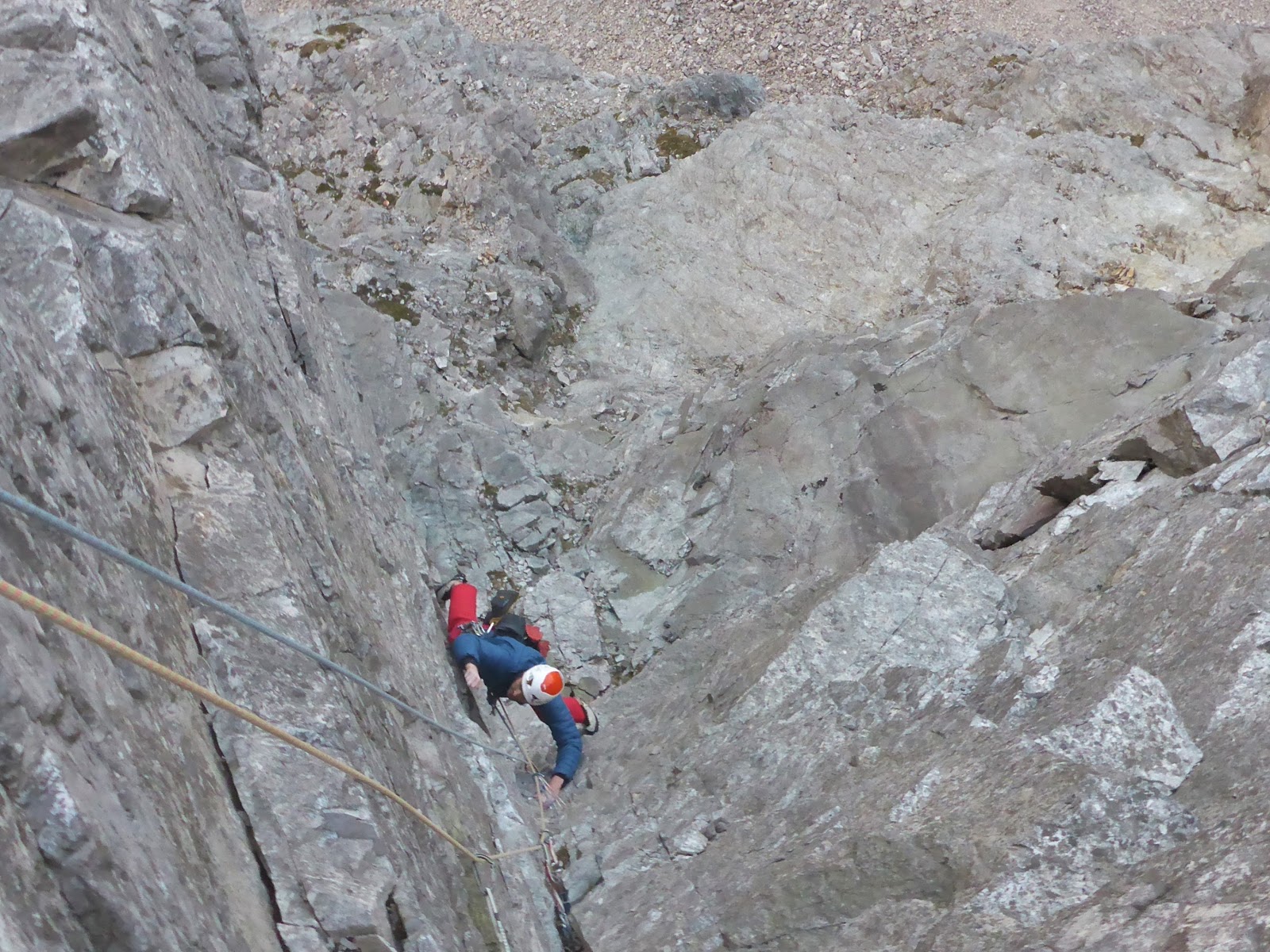
3 - Crest Route (V,7), Glen Coe

Unbelievable. Probably the most outrageously positioned winter climb (and summer climb?) I've ever done. Its also quite hard which all in all makes for one hell of a day out!

I was speechless at the top, so i'll remain speechless now. If you want to know what its all about I suggest you go and find out!

Murlio pulling into the crux groove on Crest Route in Glen Coe
2 - Observatory Ridge (V,4), Ben Nevis

A huge, huge day on one of the biggest mountaineering challenges in the UK. The crux is low, which helps, but even then you've got a lot of intermittently technical ground to cover before things totally ease back. We did this route in a one day push from Stirling, leaving at 3 and getting back after midnight. One of the longest days I've ever had in the hills.

The north face of Ben Nevis with its winter coat. Observatory Ridge climbs the central ridge just right of the Orion face

One of the tricky mixed sections of the lower ridge

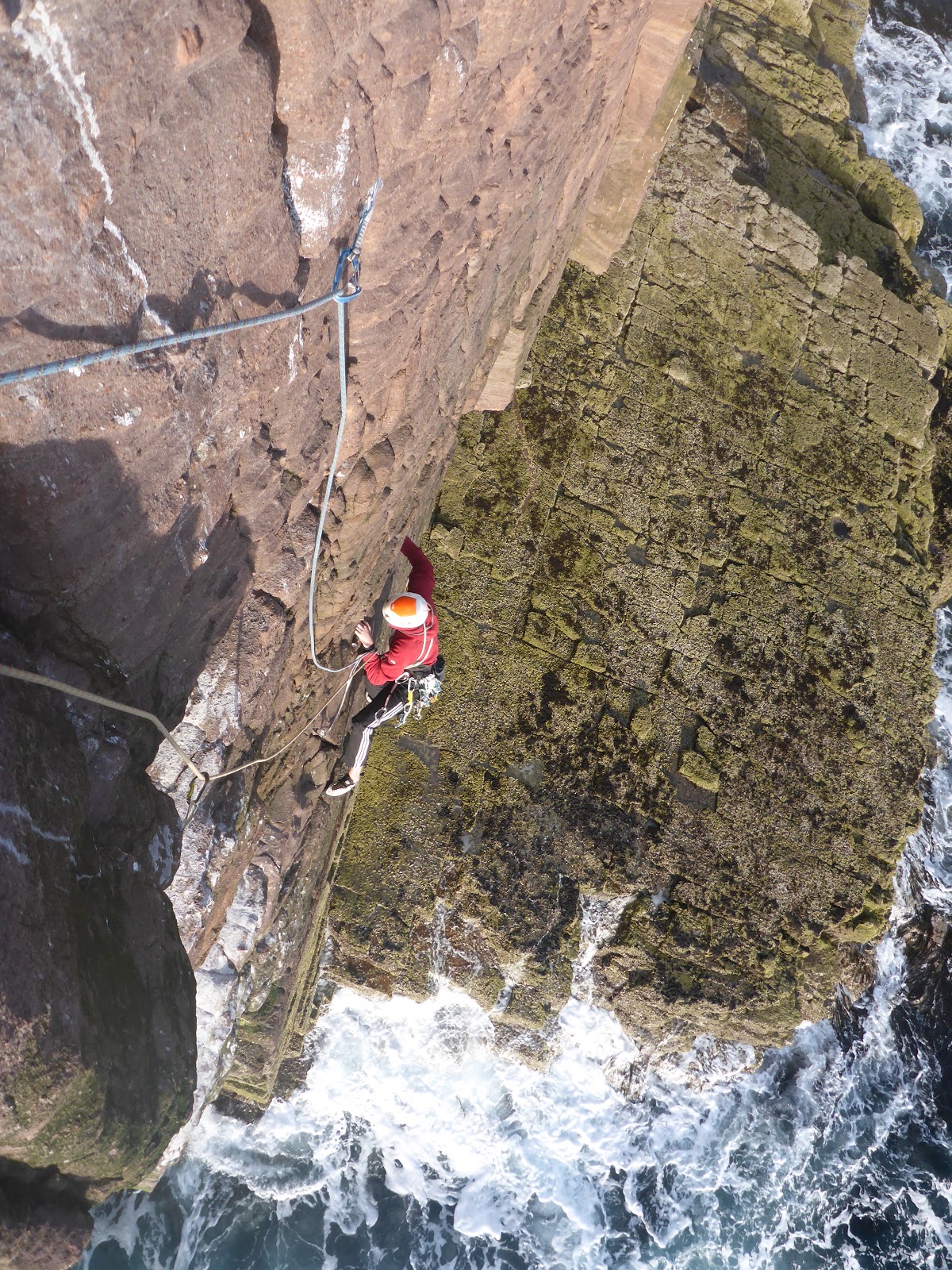
1 - Atlantic Wall (E1 5b), Am Buachaille

The epitome of adventure. The base of the sea stack Am Buachille must be one of the most remote places in the whole the UK. It might only be 5 miles from the road end, but the road end itself is 3 hours north of Inverness! The stack commands an impressive position at the base of a huge headland,  which has to be circumnavigated to the east and involves descending a rubble pile cliff before weaving between waves and sheer walls to the sea channel. All you need to do then is negotiate the north Atlantic swell and cross the 20 meter wide gap between the headland and the stack. Easy when you have a one man inflatable boat!

The classic route up the stack goes at HVS and climbs a line on the landward face. Having climbed this line before I was really keen to sample what other delights the stack had in storr (see what I did there? ha!). As it suggests, Atlantic Wall climbs the more mysterious seaward face, with only the first pitch traverse being visible from the ground. It really was like climbing into the unknown and what a hell of a place to do it!

The first pitch climbs a short tricky crack before making a long traverse out above the frothing ocean cauldron before a few thin rounded moves through a hanging overlap lands you on a small belay perched right on the arete above the waves. The next 2 pitches climb a short and burly hanging crack before a eventually reaching a wall and wider crack, and eventually the summit. The rock on this route is significantly better than the HVS, with reasonable gear to boot.

Sitting on top of that stack and watching the sun melt into the sea was a moment i'll never forget. Let alone this year, the day we had on Atlantic Wall was probably one of the best this decade. 

Rafe on the first pitch of the superbly positioned Atlantic Wall

The sun setting on our adventure on Am Buachaille
Anyway heres' to another great climbing year, I can't wait to see what 2020 brings.

Sunday, 22 December 2019

The daylight is gone. The skys are grey. Gunbolt metallic. Sometimes crystal, but not all that often
Certainly not at the weekend.

Early season adventures, you'd think they'd be easy. The snow just a dusting, the ice still on its way. Yet this year every trip out has been wading. Powder as deep as the thigh or perhaps deeper for those under 5'10. Step, push, step, push. The effort of moving is enormous. We're going downhill and yet it felt impossible. Poles pushing me forwards, but heavy feet, heavy legs, heavy bag, pulling me back. 
This for miles. Or at least it looks miles. In the white, distance lies in the eye of the beholder. The task was as mortifying as the methodical thoughtless nature of it, is one to relish. 

Hoods are up. The wind is dropping but the view grows faint. The hill goes flat, then up, then back again. We pass between boulders. Some big, some small. The Shelterstone is enormous, but the holes beneath other rocks are bigger. Could swallow a man whole, especially if its not a whole man. 

Settling down under 20 feet of granite. Sleeping like that you live for the moment, Its been still for an age. A sentinel for adventure, safeguarding those who venture into the wild. Strange to think its occurrence on the valley floor could be a product of such violent beginnings.   

The frost is everywhere. It  covers the walls, fills the torch light. 
Step, push, step, push. This time steeper and only up. At this hour you see little but sense everything. The brilliance of the stars shrouded behind white walls bathed in moonlight. 

In the end, the land was frozen, but the route was not. The vision of axes thunking into frozen turf 
was all it was. Good things come to those that wait, but better things come to those that go. Winter will wait, but i'll always go. After all, what is life without a role of dice.    

Walking out to Carn Etchachan after a night under the Shelterstone. A frozen landscape bathed in moonlight. 

Saturday, 17 August 2019

Climbing seems to have taken a bit of a back seat this summer. A combination of work, studying for my masters and a continued obsession with triathlon has dominated pretty much all of my spare time. My desire to get out on the rock has also been thwarted by a series of rainy weekends dwindling ambition and refocusing what I want to do with my time.

The last few weeks however I've had a few good outings, so thought I'd share some thoughts and photos of the back of those. The first outing was a long overdue weekend with Rafe, where we were hoping to find some dry mountain rock. Alas it was not to be. We did however find some serious adventure!   

Overnight rain and a more than leisurely start time was not enough to deter the ambition of getting on Steeple, perhaps one of the most celebrated routes in the Cairngorms. A simple case of mega mountain psyche clouding all sound and reasonable judgement. We should have known after fighting our way up the totally dripping and slime covered first pitch that it wasn't meant to be. None the less bravado prevailed and the battle continued well into the evening until we admitted defeat below the upper 5b corner. Cap-in-hand we climbed the top two pitches of the Needle (which were also wet) in the dark and topped out around midnight. Turns out wet E2 is hard!

Rafe on the second pitch of Steeple (E2 5c). At over 250 meters this route is one of the biggest mountain trad climbs in the UK. Perhaps we should have thought about that a little when we started up it at 14:00ish after a lot of rain overnight. Either way it was a brilliant experience, especially topping out around midnight in the middle of the plateau.  We made it back to the car by the early hours, utterly exhausted! 

Another beautiful day spent on a cold north face. I bet that sunshine was really warm too! 

The next day we took it easy and headed to Creag Dhu near Newtonmore. We had ambitions for some cool stuff but with the onset of some rain all we managed was King Bee Direct (HVS 5a) before having to bail.

I was also recently visited by Ed again on another biblically wet Scottish summer weekend. Somehow we managed a day in the sunshine in Glen Nevis followed by a few hours pre-storm the on the Sunday in the quarrys around Stirling.

Ed making the exposed step out on the first 4c pitch of Secretaries Super Direct (E1 5a) in Glen Nevis. We arrived in the Glen to showers breaking and the sun shinning. What amazing luck. The only issue was the head height ferns everywhere which were covered in water from the rain of the last few days. Needless to say we were soaked by the time we'd bush wacked our way up the hillside but it was totally worth it. The rock dried so quickly and the friction of the microschist is superb! 

Higher up on the superb arete. The next pitch which constitutes the crux climbs through a small overlap and up onto a hanging slab and other than a cam placement at the base, is totally gearless and very committing. The climbing is scary but brilliant! 

Ed on the central crack on the second pitch of Storm (HVS 5a). Whilst it looked a bit wet from below, it wasn't that bad in the end with the holds being huge and the jams being bomber. The pitch is really steep and sustained and contrasts significantly with the last pitch, with the 5a crux being a right stiffler! Thankfully it doesn't last long and whilst the crux was definitely wet, it was on jams which were sinkers so it wasn't an issue. The tree below at the top of the second pitch has to be one of the most uncomfortable places I've ever been on a multi-pitch route. As I was leading through I didn't have to stay there that long. Poor Ed!  

Warming up on Secretaries Direct (S). The rock had great friction, it just needed to be dry first! 

The next day the forecast was not so good so we stayed local and went for a session in Camby quarry. In the end we had quite a productive morning and ticked Not Easy Contract (E1 5b), Doobie Brothers (E1 5b), Malky the Alky (E1 5b) and finished off on Gobi Roof (E2 5c). All in all not a bad haul for a mornings work! An absolutely fantastic effort from Ed too considering his break from UK trad out clipping bolts and cranking on boulders. The only photo I have is from Emma who stopped by to say hi whilst out running. 
Alas summer is nearly over.
However this means only one thing.

Scottish winter is coming. 

Tuesday, 4 June 2019

A week of the wild

Spending time in the far north west of Scotland is always a pleasure. The chaotic but characteristic combination of mountain, bog, midge, rain and more rain always makes for a great camping trip. The reason we always camp is not because we're broke. The fact is we're both grown ups who own cars and pay mortgages, who have business cards and ties. We could stay somewhere nice if we wanted. Its just that camping besides a car rather than paying for a B&B keeps things flexible (which is the most important attitude on a trip to this part of Scotland). Alas, in reality such planning would infer we possessed logical thinking and forethought, so in all honesty it probably has more to do with the origin of these trips harking back to when we were impoverished students. Only now we don't tend to "mine sweep" pints and camp on the village green... 

With 7 days and 6 nights in the wild lands of sea stacks and lonely crags, this years trad pilgrimage had the potential to be the most adventurous yet. The tent was packed. The supermarket had been raided. Radio 4 had been binned for 00s trance. It was time to go. 

I've always thought that climbing is at its best when its way out on the edge. Away from polished rock and armored approach paths. Where the definitive guide is older than you are and the topos are all hand drawn from memory, on beer mat, in a pub, potentially by somebody thats never even been to the crag! Venues where gardening ability and gumption are as useful as iron fingers and expensive rock shoes. We wanted a challenge. We wanted a fight. I guess the thing about trouble is if you go looking for it, you usually find it. 

It was lunchtime and we'd already made it as far as Inverness Tesco. Although we had food and drink and snacks and batteries and jars of jam we decided we should probably buy water. Perhaps knowing our eventual destination has a higher percentage of water than the average human body meant it was neglected from our original big shop list. It didn't really occur to us until the man on the radio said there is going to be a heatwave next week. Seemed hard to believe with the car thermometer reading 8 degrees as we flew past Aviemore, snow clad peaks still glistening in the spring sunshine. Considering what our plan was that day stopping may not have been the best idea. Time really was of the essence.  

Our plan (which we cooked up on a warm comfy sofa over a beer the night before) was to monopolize a "fortuitously" late tide and start the trip with a bang on Am Buachaille. This tottering pile of Torridonian Sandstone thrust out into the Atlantic south of Sandwood Bay is often described as "the most committing of the classic 3 sea stacks". So it was with the greatest respect for one of the UKs most adventurous sea cliff adventures at 16:30 we pushed off the mainland into the swell, with an overloaded and under-inflated 1-man blow up boat towards the stack.  
 
The great sandstone stack of Am Buachille


First up was the HVS. Seems ironic looking back but the timing of our ascent that day was almost a year to the day when I'd been up it previously with my Stirlingshire pals. Funny how thing work out. The "classic" Landward Face Route climbs the worst rock on the whole stack in 2 or 3 pitches. Perhaps the most entertaining part of the climb is actually the 1st belay, which boasts a plethora of disintegrating pegs driven into brittle sandstone breaks which have filled with crud and solidified over time, all lovely tangled together by a web of rotten hemp. Bomber! 

In terms of the climbing, the first pitch is also bold as brass and starts quite steeply too. Definitely not somewhere to linger and think about how far a swim, then walk (or hop) then drive you are from Inverness A&E. Thankfully the second pitch is better, with some good rock and burly moves through an overhanging chimney crack which are guaranteed to conjure a smile. The ascent of the HVS also meant for Rafe he'd now ticked all of the classic stacks in Scotland. Such an achievement surely deserved a celebratory dram on the summit, however I'd forgotten my hip flask and the bar on the top was closed so a gentlemanly high five had to make do. 

With the HVS dispatched and the sun still just about lingering above the horizon we thought it would be rude not to have a go at the more mysterious and obscure E1 that climbs the seaward face of the stack, Atlantic Wall. A combination of its difficulty and its isolation means it receives few ascents, so the only information we had to go on from online forums was that it was tricky and it was bold... Hardly inspiring, but being such a compelling line it couldn't be easily ignored. The first pitch climbs a short steep crack (which has good gear) before making a wild traverse around the edge of the stack along a wide crack (size 4 cam plus) onto the overhanging seaward face. From there a tricky move through an overlap lands you on a super exposed and exhaustively guano covered belay ledge high above the swirling Atlantic swell. The second and third pitches climb a burly groove off the belay to a tricky wall split elegantly by a widening crack. If the HVS gets 3 stars, this route deserves 4. Better rock, better moves, better gear. Just a shame your still top out onto the same pile of biscuit blocks on the summit! After the abseil we managed to get back across just before sunset, with the darkening sky chasing us accross the moor back to Sheigra just in time for a midnight snack.

Rafe on Atlantic Wall (E1 5b)

Our exit was timed to perfection.
As the "heat wave" wasn't due to arrive until the next day and with a cold northerly still blowing we opted to stick to the coast for a little while longer. A combination of indecision, need for camping gas and a desire to use the boat again meant we settled upon a return trip to the Old Man of Stoer. Having done the classic VS up the stack before our plan was the attractive Diamond Face Route which takes a direct line up in southern arete before pulling through a large roof and weaving up the impressive upper diamond shaped head wall. Both pitches were a fight, with the lower section offering some committing arm bars and knee wedging up overhanging chimneys, whilst the sensational upper pitch makes a tricky move through a roof before climbing the remaining easy cracks, grooves and corners to the summit. A solid route on solid rock. Amazing how two stacks can contrast in their rock quality so much. Literally like chalk and cheese (or perhaps concrete and cheese would be more appropriate?).   

Rafe and I on Diamond Face Route (E1 5b) on the Old Man of Stoer (thanks Laura for the photo!)

A crucial tool for any sea stack assault 

The alarm went off. For the first time on the trip I wasn't shivering, nor had I needed the dog blanket from the car to top up any warmth in my £25 mountain warehouse "summer" sleeping bag. This could only mean one thing. 

Heatwave time. 

And we'd certainly saved the best until last.  

Foinaven is famous for falling short. Originally excluded by Sir Hugh Munro in his original list, the mountain's main summit (Ganu Mor) briefly attained formal status when it was incorrectly surveyed by the OS at a height of 915 meters in the 1990s. Nowadays its pretty widely accepted that it actually fails to reach the required 3000 feet elevation by a mere few meters. It is perhaps for this reason that the mountain maintains its allure and mystique, being an objective for those curious enough to venture onto its slopes for the sake of adventure alone and not because a list in a famous book tells you to. The unrivaled isolation and opportunity for a adventure was a tantalizingly poisoned chalice, and so with our Tesco bags in-hand we started the 10 km walk up Strath Dionard to the mighty cliffs of Fionaven. 

Our chosen campsite was a heaven of flat grass among a sea of tussocks and peat hags. Positioned no less than 10 feet from the edge of Loch Dionard and surrounded by humongous cliffs and even a waterfall, it felt like a set from The Lord of the Rings. The upper glen was also a definition of absolute stillness. No roads, no people, no signal, not even any paths (which my wet feet would attest to after stepping into a knee-deep bog twice in 100 meters on the way in). Not wanting to waste the day we pitched camp, racked up and headed over towards the towering Creag Urbhard. At nearly 200 meters high it feels somewhat disrespectful to call our afternoons endevours craggin, but that's exactly what it felt like it was going to be. The walk-in from the tent would take less than 10 minutes and we'll be able to see our campsite oasis set amidst the moonscape for the duration of the climb. The route we choose was Iolaire, a  direct route up the left hand end of the buttress, with the highlight being an overhanging 5b chimney on the 3rd pitch. 

Moments after starting out it became immediately obvious that this was not "craggin" and that conventional climbing techniques were going to be of no use here. The rock, a heavily metamorphosed sandstone quatzite (similar[ish] to Gogarth), some of the oldest in the UK, was highly fractured yet somehow very compact. This meant that the rock appeared solid but holds could be easily pulled off if not thoroughly tested. Most importantly however, it had very little opportunities for protection and belays, which when faced with a cliff that size is enough to make the hardiest esoteric protagonist question their motivation. Whilst the chimney pitch was superbly exposed, the best pitch actually turned out to be the 4th (4c) corner, which was simply brilliant and deserves a bunch of stars in its own right! The other pitches all had a fair amount of filth and loose rock, but were still amicable.   

Loch Dionard and the might cliffs of Fionaven. Perhaps also the first ever visiting Tesco bag for life 


Pitch 2 of Iolaire (HVS 5b)


Rafe on the amazingly positioned 5b chimney on Iolaire

Over the next couple of days I started to fall into a routine of climbing existence. Waking up as the sun warmed the tent. Going for an occasional swim in the icy loch then lying on the beach and basking in the deafening silence and isolation, only for it to be broken by Rafe asking from his sleeping bag where his coffee was. After a breakfast comprising of porridge and half a jar of jam we'd gear up, taking only a handful of snacks and head out, knowing full well we'd not be back until night fall. Being scared kind of spoils your appetite anyway. As we started to get the measure of the place routes started to fall by the wayside, Gargantua, Whitewash, Cengalo, Marble Corner. All massive. All mountain. All loose. All committing. All an adventure.
Gargantua (HS 4b)


The crux slab of Cengalo (VS)

Marble Corner (HVS 5a)


Campsite kitchen. Yes, before you ask, he's grating cheese with a spork.

We'd saved something special for day 4. Everything we'd climbed so far would be preparation for this day. If the main bastions of the Dionard Buttresses and Creag Urbhard were mysterious, then Lord Raey's Seat was by all accounts a total unknown. After all, for somewhere to have a reputation, a few people must have gone there (and made it back to tell the tale!).  

Set high up in the shadows of Ganu Mor, Lord Raey's is a bastion of Scottish Mountaineering. With few routes relative to the size of the cliff, it has probably only recently risen to its current meager fame (or infamy?) since its publication within Great Mountain Crags of Scotland. Indeed this book one was of the only sources of information we could find on the routes on this buttress other than the guide, which explicitly stated that "if hollow blocks make you nervous, this isn't the crag for you".

Challenge. Accepted.

The morning was cool. The sky was bright and clear. The peat creaked and the gravel crunched as we bounded up into the moonscape of Coire na Lurgainn. If the base of the Starth Dionard felt isolated, then this place was on another level. Rocks and desiccated peat soil ran as far as the eye could see. The river in the bottom barely had the energy to cut itself a channel, instead surrendering to the solid bedrock beneath and scattering among the many boulders and hollows from when the glaciers left, which looking at the landscape could have been yesterday. As we climbed higher into the Coire, vertical walls rose up and surrounded us, forcing us towards our objective, making our destination a total inevitability. Eventually bubbling rivers gave way to ribbons of scree. Blocks bigger than houses. After sacrificing many steps back for every step up we made it up the talus the base of the crag. Although its broken by a few horizontal ledges, the buttress appeared to bow out above us, like standing beneath the prow of a magnificent ship, the white lichen clad quatzite scattering light in every direction. Thank god I had sun cream. 

First up was Breakway, an E1 where the "E" is for excitement. The line climbs a series of corners, grooves, pedestals and chimneys in 4 or 5 pitches up some of the most horrifyingly loose and steep rock I've ever climbed. Adventure is what we came for and adventure was what we were getting. Perhaps the highlight of the route was at the top of pitch 2. Rafe having climbed a bold groove reached the top only to find the exit totally covered by an assortment of precariously perched "death blocks". It was also whilst on this route we saw the only other person we saw that whole week. Ambling along the ridge in what they thought was total solitude, they must have been quite surprised to see two colorful blobs fastened to a giant vertical hobnob. 

Sat on the top of the crag looking over Arkle and the rest of the northern Highlands which were glistening in the afternoon sunlight, I remember thinking that this places makes Skeleton Ridge on the Isle of Weight feel solid...

Lord Raey's Seat basking in the morning sunshine


The first pitch of Breakaway (E1)


Rafe high on the first pitch of Leftfield (E2)

The final tricky corner of Leftfield on Lord Raey's Seat


For whatever reason, we decided we needed more. Any sensible person having survived a round with such a crumbling beast would have probably gone home and had a good old think about what they were doing with their lives. It was only 15:00. Foinaven isn't even a Munro. We've got time for one more. Rafe's pick. Leftfield was actually in the book and came recommended so it has to be better than Breakaway right? Quite a serious place to climb E2. No matter, at least we've got plenty of day light. It won't get dark until September. 

If Breakaway was horrifying loose, then Leftfield was unnervingly hollow. The route was hard and steep. So whatever hold was there, you had to use regardless of its level of attachment. The crux is also the first 10 m of pitch 1. As I watched Rafe gingerly ascend the initial groove, I'd be lying if I said my heart wasn't in my mouth. I felt as much panic as he did when the crucial foothold snapped and he somehow held on. Nothing but fresh air beneath him apart from the small cam behind the exploding flake below. 

When I grabbed the last hold on the final 5b corner, it felt like we'd cheated death. I gave Rafe a shout to say I was safe. The first time I'd said it all day and actually meant it. The belays. The blocks. In my mind I vowed to never venture onto that face in summer again. I was done with choss. However as we sat on the summit of the crag, watching the sky grow from a deep red to lilac and purple, making shadows dance across a land as ancient as time itself, all the terror of that day, indeed the last few days was forgotten. 

Miles from people. Miles from the road. Miles from the path. Miles from anywhere. Intoxicatingly addictive isolation. We walked out the next day with lighter bags, but heavy hearts. The normality of life was beckoning. 

Saturday, 18 May 2019

It was not the winter we all hoped for. Dreams of a repeat of last years seemingly endless abundance of thick chewy ice weekend after weekend were crushed following a week of high summer in February, but it wasn't until March when everything was stripped again that all hopes of getting some descent stuff ticked were truly thwarted. However, even amidst all the heartache and longing, the cold was around for long enough to whiten the cliffs just enough for a few mad but sucessful missions.

Fresh snow and swirling winds were apparently loading slopes left right and center. The solution to this debacle was to go somewhere that would be high enough to be well within winters grip but also that minimized the amount of time we'd be wondering through risky terrain. Ben Cruachan and its Munro height winter corrie seemed to fit the bill nicely. Perhaps the classic of the crag, Tainted Elixir, proved to be a worthy adversary being buried under a considerable layer of powder and cruddy ice which made it earn all of its grade of V,6. The next day we went in search of more adventure in the Loch Avon basin. Unfortunately the snow conditions weren't playing ball, looking extremely loaded on our descent aspect. It also didn't help that it was thigh deep in places making for some spectacularly long stints of wading and crawling. In the end we opted for Wobble Block Chimney (IV,5), which apart from the top pitch was pretty average and only just worth the walk.   

The approach up past the very eerie Cruachan dam

Rafe battling through pretty challenging conditions on Tainted Elixir (V,6)

Topping out in the storm (still!)

Wobble Block Chimney (IV,5)
The final outing of the season was a big one. With a return to cold conditions due to be followed immanently by some substantial warming we grasped the opportunity by both hands and rode it all the way to the north face of Ben Nevis. The route of choice was Point 5 Gully. It was always going to be a long shot based on just how little snow and cold there had been this year and so it was pretty sad (but unsurprising) to see gaping holes in the ice on the first pitch. Not to be dismayed, we opted for our second choice, Observatory Ridge (V,4) which was thankfully coated in snow and ice from top to bottom. After quickly dispatching the difficulties lower down, we found ourselves enjoying a particularly calm and settled day on the well consolidated upper ridge with wicked views and brilliantly hard and chewy neve. Its perhaps a bit unfair on OR to call it a consolation prize, as at nearly 500 m long, its one of the biggest routes on the Ben and was a major undertaking. We left Stirling at 3am and didn't get back until after midnight with the route alone taking nearly 8 hours. The next week it got warm and that was that. 

Not a bad morning view

Looking up one of the crux grooves on Observatory Ridge (V,4)

Seb high on Obervatory Ridge, just before joining Zero Gully