Thursday, 31 August 2017

Auchinstarry Again

This week saw another post-work climbing session at Auchinstarry Quarry near Kilsyth. We warmed up on Spirogyra which is an un-starred VS 5a on the right side of the Promontory. Although much of the line is shared with the far superior route of Promontory Direct (HVS 5a), Spirogyra is definitely a good route in its own right with some steep and interesting moves on big holds around on the more obscure side of the Promontory. Having done the direct a few months earlier I knew the off-width at the base was going to be a fight but I’d forgotten just how awkward it is! I was definitely warm after battling with it that’s for sure!

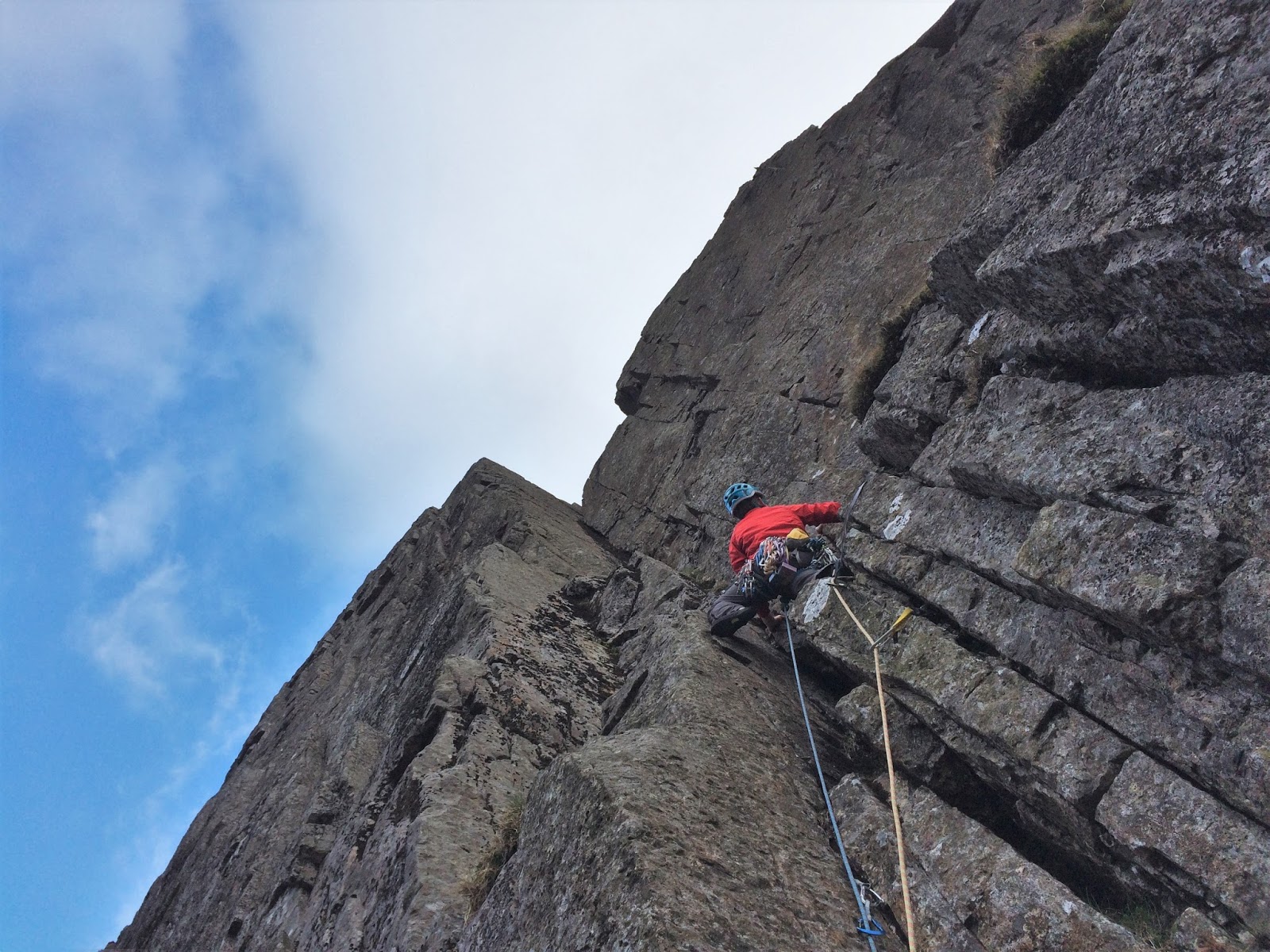
Nicolas moving round onto the awkward ledges before the steep head wall on Spirogyra VS 5a
We then nipped round the corner and Nic lead a Severe called Tar. Although it had some good moves, it was quite sparse on gear and actually quite loose, which is a surprise given the volume of polish it had on it…

With time for only one more climb we headed round to the little amphitheatre, a more esoteric and quieter section of the quarry adjacent to Mascaraed Buttress. The line was Orange Flash, a seemingly little traveled HVS situated in an open corner. Looking down from the top the route was full of cobwebs and plants and the holds full of soil, so I opted to abseil the line and give it a clean before our ascent. Once unearthed the route turned out to be a real gem, with an easier lower half and a much tougher top section with steep and compact side walls with only a thin finger-tip crack running to the top. Its perhaps one of the best routes I’ve done at the quarry and definitely deserves more traffic.

Nicolas bridging the corner on the brilliant Orange Flash (HVS 5a)
A photo of Nicolas from a few months ago on Red Lead (VS 5a) on Mascaraed Buttress just round the corner from Orange Flash

Thursday, 24 August 2017

Auchin' on the Wild Side

Auchinstarry Quarry is quickly becoming one of my most favourite crags in the central belt. This trip I managed to do a route I’ve been eyeing for a while now. Walk on the Wild Side (HVS 5a) climbs straight up the middle of a large slab hidden in a more quiet part of the quarry. The line itself starts just right of Trundle (which is a wicked VS 4c) and aims for a faint crack at about 10m then follows it to the top. The gear is small and so are the holds, so it’s surprisingly absorbing for route only 20(ish) meters long. Perhaps one of the best slab climbs I’ve done and if it were at a nicer crag would almost certainly be a well-known regional classic. 

Looking down onto the top of the slab with the pond just beyond (Taken by a passer by)

Fran floating up the final crackline


Monday, 21 August 2017

Loudoun Hill

Managed a quick morning session in between showers at Loudoun Hill in South Lanarkshire this weekend. After warming up on Pulpit Arete (Severe) I then managed to get Pulpit Crack ticked. Both routes are totally great, with the former being surprisingly balancy for a S and the latter being totally the opposite. Pulpit Crack is a totally overhanging HVS fist crack / corner that joins the arete near the top. The crag itself is a weird igneous alkaline sill that forms this amazing conical hill that towers over the surrounding bog. The crag is most famous for a route called The Edge (VS 4c) which climbs this amazing looking partially detached tower.. One to go back for..

On the upper arete after the lower thrutchy section of Pulpit Crack (HVS 5a)

Tuesday, 1 August 2017

Hoy - A Lifetime Tick

There are many routes that i'd like to climb, inspired by pictures in magazines and guidebooks, or compelling reviews from online blogs. These routes are perhaps famed for their adventurous nature, stunning position or quality of climbing, where an experience is so good its likely to linger on the taste buds for days following an ascent. There are a few routes though that are supposedly so incredible that they become defining, generating memories that will never leave you and ever since I started climbing, these routes have completely captivated my imagination. The Original (East Face) Route on the Old Man of Hoy is one of those routes.

With the forecast for most of the Scotland looking pretty grim, Orkney offered an unlikely salvation from a lingering low pressure system which was fabled to be well and truly grounded a few hundred miles off the west coast. Climbing Hoy had been in the back of my mind this year, but I didn't actually think it was going to happen. The weather forced our hand, so we took a risk, and booked a ferry. 

Orkney is a fascinating place, green, flat, with cows sheep and crops in every field. It's a very stark contrast to the landscape of Caithness in the far north, which you drive through to get to the ferry port. As we wound our way ever closer to the end of the A9, it appeared that outside of the fertile strip around the coast, the landscape was dominated by moor and bog as far as the eye can see. Orkney offered a comparatively lush haven, that is if you discount the island of Hoy. Sat just south of the Orkney 'mainland', Hoy is a hilly, heather clad giant, which is now days in-part famed for its sea stack, but also for its sandstone sea cliffs such as St Johns Head, which is the third highest sea cliff in the UK (after St Kilda and Foula) and is a staggering 375m high. A truly unique place.    

With only a small weather window we got the first morning ferry over to Hoy and made a beeline for Rackwick Bay, the start of the walk-in. 3 miles, a big hill and a few showers later we arrived at the top of the cliff, getting our first glimpse of what lay ahead. Curiously the headland which faces the old man, isn't actually as high as the stack itself, which definitely adds to the intimidation.

It definitely didn't look that big from the ferry to Orkney!

Our first glimpse of the stack. The original route climbs the centre crack line then the rightwards trending fault line to a final corner crack just right of the summit. The route is 135m long and is graded E1 5b. 

A photo taken by Tim Simmons a few hours after we started climbing
We climbed the route in 5 pitches, with the 2nd pitch and the final 5th pitch being the most notable. There are plenty of blogs and reviews out there that critique the climbing and break the route down hold by hold, which I will not be doing. The only thing to note is that there is a lot of fixed gear, and before you ask, yes most of it is in a hell of a state and we did back up the abseils (of which we did 3 in total). The rain started just as we reached the top, and didn't stop until we reached the bothy in Rackwick. Luckily the climbing was mostly dry! Phew! 

The first pitch leading to the Galley
Rafe stepping out just below the overhanging chimney crack

A photo of Rafe just pulling through the roof crack on pitch 2. Photo kindly provided by Tim Simmons.

The final steep corner crack, just before the bulge. At this point you can see all the way through the crack out the other side of the stack!

Rafe just finishing the tricky section of the huge corner on the last pitch

Signing the book just as showers move in from the south
The smile is for finishing or for reaching our lunch? 

Rackwick drying room bothy! 
This climb is one of the best adventures I've ever had. If this route is not on your list. It should be.  Special thanks to Rafe for driving from London to Orkney in less than 24 hours and also to Tim Simmons and his wife, who happened to take some photos of us on the second pitch whilst out on a walk the day we climbed it and approached us on the ferry. 

On a final note we also visited a few Caithness sea cliffs whilst making our way North. We visited Mid Clyth and Latheronwheel, both of which were absolutely superb and well worth a visit. 

Getting in some extra drying time in waiting for the ferry at Lyness

Stealing some climbing between showers at Ysnaby on Orkney

Not a bad car park for the walk-in at Mid Clyth. Dream House?

Off-width chimney climbing down at Mid Clyth

Typical last-day-of-trip weather at Mid Clyth


Monday, 24 July 2017

Skeleton Ridge - The Needles Isle of Wight

The reasons why people climb are many and varied. Some people climb for the joy of movement. Some people climb for the adrenaline rush. Others for the adventure. What reason did we chose to climb a crumbling chalk cliff then? Well I guess adventure was definitely our reason, as it couldn’t have been either of the other ones...

Although it is generally a little know route, Skeleton Ridge is probably the most well televised rock climb in the country (it’s just all those people watching the BBC One program introductory image of the Needles and the light house didn’t know what they were looking at). The line climbs out of the sea up and along the knife edge arête along nearly 200m of climbing back to the cliff top. Its famed in part for its poor rock and lack of any meaningful protection but mainly for its mind blowing exposure. How could we say no? We booked our ferry and grabbed our bikes and off we went on one of the best adventures I’ve ever had.

Reading about the details of a route can be a bit tedious and uninspiring and for those intending to scale its heights, may spoil the thrill of your adventure. So instead of describing everything in detail I’ve posted below a load of photos plus few tips if you are thinking of giving it a go.. I hope you enjoy!

1) Buy Pat Littlejohn’s West Country Climbs V2 – It’s got loads of tactical advice and most importantly numbers for the Battery and the Coastguard, who both need informing before an attempt is made.
2) Check the tide – If you can’t be at the base of the cliff within an hour of low tide don’t bother. The last 100m of walking is most definitely tidal. The tide came in too much to walk out by the time we’d done the first pitch.
2) Call the Battery – The National Trust manage all of the land at the top of the cliff at the Needles. The abseil stake to descend the cliff is within the fence boundary and you’ll probably need the staff to help you find it (its location is at the head of the ‘moat’ on the right and requires you to down climb a section of collapsing wall above the cliff). A chap called Cameron came in early to meet us so we could make the tide.
3) It’s not a winter route – you don’t need an axe, so don’t bring one. True the rock is truly awful in places, but the idea of smacking a peg in for us was too incomprehendable. The hardest parts have already got pegs (for now..) so probably don’t bother. We had a set of DMM wallnuts and a load of slings and that suited us fine, although how well they’d hold a fall is a different matter.
4) Use 60m ropes – the last pitch is only about 20m of (shit-yourself exposure) climbing but you need to walk about 30-40m to the lookout fence for a belay. We only just reached it with 60s!

5) Do it soon! – It’s not a route to wait for, as its certainly not waiting for you!     

The Needles. Skeleton Ridge is obscured by the cliff you abseil down

Rob on the abseil into Scratchells Bay. We used a 60m static plus a 50 dynamic from the stake and had about 20m spare

Nearing the base of the abseil. The amount of chalk that was kicked loose during our descent was unnerving to say the least! 

Looking along the deserted beach of Scrachells Bay

The tidal bit of the approach to the base of Skeleton Ridge. The first pitch climbs up the slab just to the right of the first tower

Rob seconding the first pitch. Some imaginative runners using flint 'chickenheads'

Rob starting the second pitch on the ridge proper

Me clipping the pegs on the first 4c pitch. Wind was getting quite strong at this point! (Photo Credit Rob Steer)

Moving through some pretty exposed terrain on the upper pitches (Photo Credit Rob Steer)

(Photo Credit Rob Steer)

The wind was so strong by this point it was blowing our slings off..

Rob straddling the mind blowingly exposed ridge on the final 4c pitch

Looking back down the ridge. Perhaps a view that won't look like that for much longer?

Looking along to the belay at the Battery after the last pitch

Thursday, 20 July 2017

A Reoccurring Theme

It's funny how some places stick in your mind. Following a visit to the cliffs of Sca Fell earlier this year I found myself obsessing over guidebooks and online blogs reading and researching the many rock climbs that weave across its buttresses. The climbs we did, Botterill’s Slab and Grooved Arete were definitely some of the most inspiring and absorbing climbs I’ve done in the Lakes, so I was keen to discover what other gems might be harboured on those mighty walls. Names like Moss Ghyll Grooves, Moss Ledge Direct and Jones' Arete and Mickledore Grooves all classic MVS/VS grades with reputations for being shy and adventurous. My climbing partner Rob (who walked up with me in 2016 when we were turned back by rain) was in agreement for another trip. Now all we needed was a dry Saturday!
The mighty Sca Fell East Buttress

As we drove down the valley the road surface was still damp and fog clung to the peaks at around 2,000 feet completely obscuring our objective. No matter though. The forecast was for bright skies with a gradually strengthening wind. By the time we had slogged up to the base of central buttress the fog was thinning and there was even the odd burst of sunshine. None the less, the climbs on this face looked cold and uninviting, streaked with patches of damp with the top of the crag still in fog, giving the impression of an endless wall towering into the sky, so we continued around to East Buttress in the hope of some drier rock and sunshine.

The climb we opted for was Mickledore Groves. A well regarded VS with a particularly stiff 5a start up a small overhanging wall. The guidebook described previous ascensionists bouldering this bit and having gear thrown up to them whilst sat on the narrow ledge just above. We both thought that sounded a bit of faff so I decided just to lead it with gear but do it quickly. It took a few goes up and back to the ground to figure out the holds but eventually went for it and in the end it didn’t even feel that tricky! The rest of the pitch climbs a gangway followed by an awkward corner, with a cramped step across into another groove, before a spacious belay is reached below the slab. Rob lead the second and final 4c slab and corner pitch up to the top of the buttress. The pitch was quite sustained and very balancey, quite a contrast to the thuggish first pitch and definitely no soft touch at 4c.
Rob seconding the first pitch of Mickledore Grooves (VS 5a)
Rob just stepping onto the technical slab on the second pitch of Mickledore Grooves (VS 5a)

Looking back down the main corner from the top of the second pitch on Mickledore Grooves (VS 5a) with a party behind just starting the slab
 With most of the fog burned off we moved route to the central buttress for the main objective of the day, Moss Ghyll Grooves. This climb is described as a typically shy Lakeland classic, often encountering a few wet patches and only in condition after a lengthy dry spell. Furthermore, its grading of “mild very severe” (MVS), a grade unique to this part of the world, cements the route as a true Lakeland star.  It essentially climbs a slabby groove on the right of the main face of central buttress in 3-4 outstanding pitches. The main event of the route is a tenuous 4c traverse out of the groove line onto the arête just above the belay on pitch 2. The intimidation one feels on this crag is indescribable and in reality quite incomparable, perhaps the shaded aspect and its general historical significance combine with the apprehension of vertigo making it feel like you’ve swallowed a swarm of particularly lively butterflies. In the end the pitch was a joy to lead with only a few tricky 4c moves across to the arête where the climbing eased and the exposure exploded. The other pitches were equally interesting and exposed and should be on the list of any adventure loving climber!   
Ron nearing the end of the first pitch, just below the technical 4c slab pitch on Moss Ghyll Grooves (MVS 4c)

Looking down the second pitch from the Look Out on Moss Ghyll Grooves (MVS 4c)
Central Buttress on Sca Fell taken in April

Monday, 29 May 2017

Now't but us up here

Looking across the the top of Grooved Arete towards Central Buttress on Sca Fell

A few weekends ago in April myself and Matt ventured up into the high mountains in the Lake District on the promise of dry rock. High pressure positioned over the North Sea and Scandinavia meant it hadn't rained properly for weeks. Farmers in Kent were threatening of poor crop yields and the government were issuing reports of river levels being at an all time low. For us climbers, this news triggers only one thought. big mountain season has come early!

Don't get me wrong, it was still supposed to be cold. Strong easterly winds were forecast to be blasting the high peaks all weekend with variable cloud cover and maybe even a shower or two. Hardly big mountain climbing weather I hear you say. None the less, the temperature gauge read at a steady 14 degrees on the dashboard. Flicking my glance between that and the blue and cloudless sky on the drive down through the Southern Uplands I thought a promise of poor weather felt unlikely. Still, I thought such a classic crag, folk will be taking a punt on the weather and going for it, surely?

I've walked up to Sca Fell once before with Rob last October. It had been dry for a few days and optimism and enthusiasm combined with the season coming rapidly to a close meant we chanced it and walked up to Central Buttress. Unfortunately (or perhaps fortunately) for us the face was soaking. Streaming with water, our hands stinging with cold. The face may as well as had 'closed' sign hanging at it's base. However seeing the buttress up close, picking out the classic lines weaving through such steep ground, I knew I'd be back!

After a short but sharp climb up from Wasdale Head passing more 'three peaks' competitors than I care to imagine, we arrived at the base of the buttress. It's aspect means it only gets the sun very very early and again in the evening. The face looked dry, cold and a little uninviting as it loomed intimidatingly over us! Surprisingly, the cold weather seemed to have put other optimists off. 'Now't but us up here'. We had the whole playground to ourselves...

On the other side of the Cwm, bathed in morning Sunshine was Pikes Crag with its most popular and classic route, Grooved Arete soaring 110m up its prow. We had food and we had time, so we opted to warm up (literally) on that first. Interestingly myself and Rob had attempted climbing this route in the rain last time I was there, only to be turned around 2 pitches in by pouring rain and freezing fingers. Unfinished business indeed!

Matt linking some pitch at the start of Grooved Arete (VDiff). A great pitch in its own right|!

Matt seconding the final feet of Grooved Arete, Pikes Crag 

The route was delightful and considering its blocky appearance, quite sustained in places always being interesting. Following a quick abseil to get down off 'pulpit rock' we waded down through the hoards of people heading up to Mickledore and onto Sca Fell Pike and geared up for the main event.

Central Buttress was still covered in cloud but it was now or never. The route we opted for was the mega classic Botterils Slab, one of the most eye catching lines on the whole of the face and comprises of 3 quite long and very contrasting pitches, the second of which is the show stopper. A full 40 meters of technical 4c climbing up the arete and narrow slab. Hard to believe it was first done over 100 years ago by a chap wearing hobnailed boots with an ice axe in one hand. Kudos to you Mr Botterill!

For any likely ascentionists the first and second pitches are good value, with the second particularly being quite thin on holds and gear in its lower section. We both thought the third and final pitch was a bit confusing and a bit loose (loose by mountain standards but if you've climbed on the Culm then you'll be right at home!). I've attached some photos to keep the interest and I hope you enjoyed reading about our adventure!  

The first 4b pitch of Botterill's Slab (VS 4c), steeply gaining access to the main slab pitches

Matt in the middle of the crux 

Just before the final crack high on the arete of Botterill's Slab (VS 4c), Sca Fell