Sunday, 10 January 2021

Sunrise at Ben Lomond from near the descent into Coire a' Bhathaich

With some warmer weather on the horizon it felt like it was now or never for having another go at climbing on Ben Lomond. We'd walked up there in early December and been confronted with very marginal conditions, despite several days of freezing winds and snowfall. In the end, it took nearly three weeks of subzero temperatures to freeze the turf and form up some good snow & ice. 

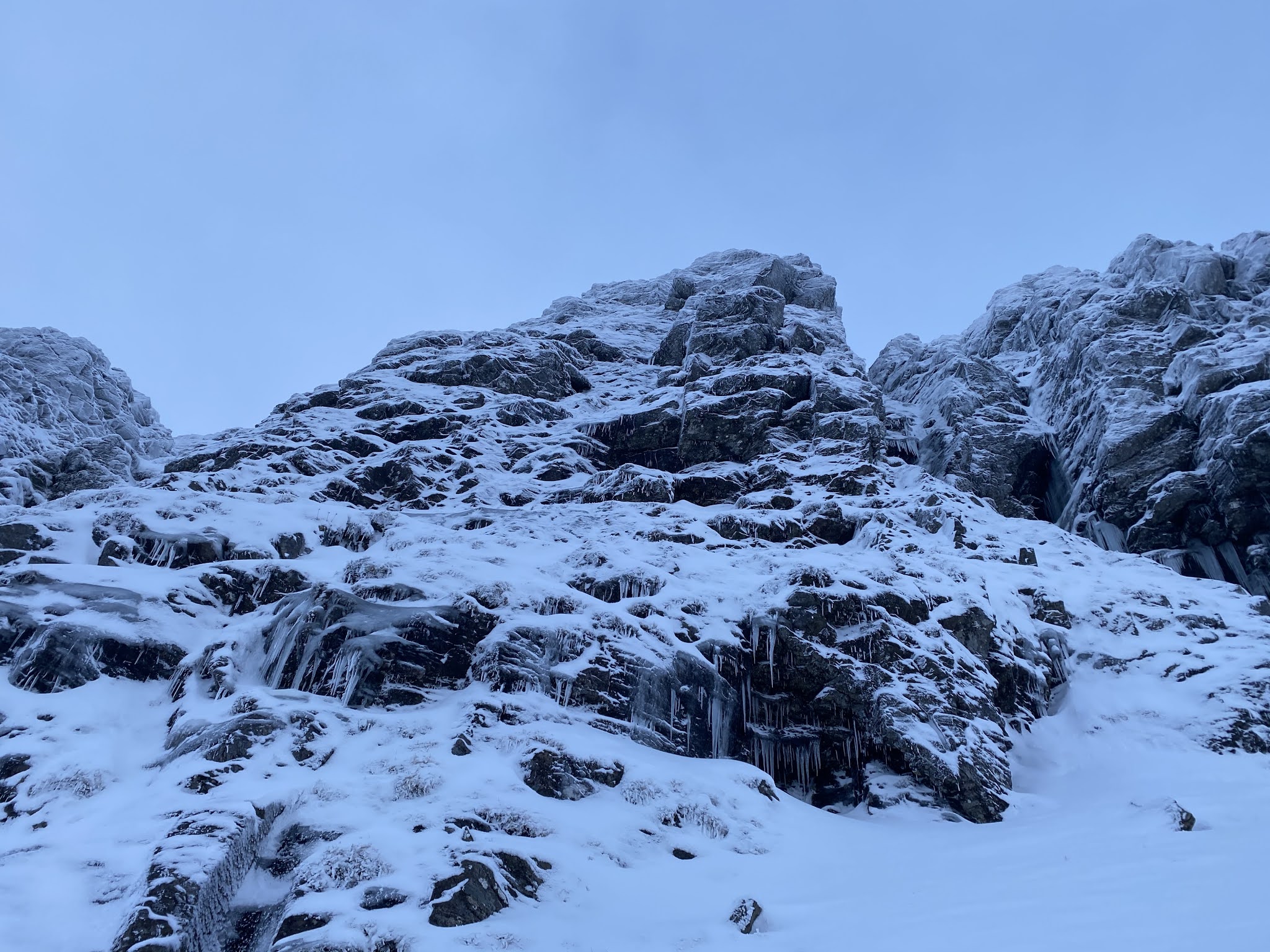
The plumb line of the crag which is positioned on the gloomy north side of Ben Lomond is without doubt the compelling Lomond Corner (IV,5), situated on the left of B Buttress. The easiest way to reach the corner is to walk up the summit path to a bealach, which is ~300 m before the summit. From here a steep grassy slope can be descended under the imposing A Buttress into Coire a' Bhathaich. Around to the left is Pioneer A Buttress, which along with many folk before us had been confused with A Buttress. From the descent Lomond Corner gradually comes into view and is probably the best feature to use to work out the rest of the crag. Its worth noting that the start of the corner is at ~750-800 m and is sheltered to all but the coldest north westerly winds, so if conditions aren't good when descending from the bealach you'd be best abandoning the corner for a more exposed climb on Pioneer A Buttress which is more likely to be climbable. 

Looking up the first pitch of Lomond Corner (IV,5) with the fantastic upper pitch visible beyond

Seb seconding the fantastic main pitch of Lomond Corner

The easy lower corner has a few steep vegetated steps but is otherwise pretty uneventful and leads to a belay that needs a lot of searching out (good nut overhead). The upper corner is definitely the main event and provides a huge 60 m pitch up the right angled corner using turf, rock and snow. The difficulties low down are reasonably well protected and soon ease with height. The crux is maybe 10 m off the belay where the turf thins to a steep slab and the vertical wall on the left pushes overhead slightly. This section had some useful ice and good solid blobs of frozen turf in the back of the crack but even then my partner who seconded the pitch thought the grade could easily be IV,6. Above, the angle relents, but is essentially without protection and those with shorter ropes hoping to take a belay before the top would really struggle to find anything meaningful.     

Lomond Corner definitely deserves a few stars and is worth seeking out, but only after a substantial freeze.   

Seb seconding a tricky step on Shoogleniftt (III,3)

Grooves and turf all in great icy condition

Watching the moon rise over Loch Lomond certainly makes getting up so early feel worth it 

And if you're wondering... Ben Lomond is within Stirlingshire, the county where my climbing partner and I both live.

Monday, 4 January 2021

Third time lucky

The far west buttress of Beinn an Dotaidh in prime early season winter condition

We'd walked up to Beinn an Dotaidh twice before and been met with varying degrees of soft turf, bare rock and rain. The disappointment of finding your objective unclimbable is crushing, which is unsurprising given how much you can invest when choosing winter climbing routes. You spend hours and hours studying guidebooks, live weather data, forecasts and social media. After meticulously piecing together the puzzle you then haul yourself up a huge hill only to find out it was all for nothing. Needless to say, winter climbing is always a roll of the dice and conditions in the mountains can change so fast, but it still sucks when things don't go your way.

Luckily for us, this time Storm Bella had delivered the goods in terms of winter climbing conditions. Freezing northerly winds combined with fresh snow had totally plastered many of the hills and high cliffs. This was our third attempt at winter climbing on Beinn an Dotaidh and it was a great relief to finally see everything looking so white and frozen in the early morning light.    

The first route we climbed was Pas De Deux, a grade V,6 which weaves a wandering line on the steep wall overlooking the central gully climbed by Cirrus. The route is described in the SMC Scottish Winter Climbs as a "neo-classic" (whatever that means!) and is one of the few routes at the crag awarded 3 stars so was an obvious choice. The first pitch climbs some turfy grooves with a steep pull to a thread at about 25 m. If you suspect that the turf is not frozen and there isn't much ice or snow this is definitely the point to bail! The next section of the pitch makes a traverse left along a narrowing ledge, where a few small wires can be arranged before a committing step is made up into another groove. The climbing was mostly just awkward steps between sloping foot ledges with nothing for axes other than thin ice used for balance. After this tenuous series of moves a ledge and a peg is reached and offers some relief before further traversing on icy slabs leads to a belay left of a corner. This corner and the next one above it provided further entertainment being a little thuggy, with much of the gear hidden by snow and ice. The guide suggests that a "zig-zag" should then be made to a thread belay overlooking Cirrus, however conditions were icy enough for us to make a more direct line consistent with routes grading and avoiding massive potential rope drag. The last pitch of tricky climbing up an icy chimney and subsequent corner crack is absolutely fantastic. The ice on the lower chimney was good for climbing but too thin for screws, making it quite committing but no less enjoyable. The upper corner itself was steep and broken with ample hooks and gear and more than makes up for the lower pitches being so sketchy. 

Seb teetering on frozen blobs up the crux pitch of Pass De Deux (V,6)

The spectacular upper icy groove and corner beyond near the top of Pass De Deux 

With cold prevailing we returned a few times over the next week or so, climbing a few of the other "classics" of the crag as well as some of the more rarely trodden lines. 

With Pass De Deux in the bag, the obvious choice was to try Menage a' Trois, another V,6 that is allegedly slightly harder but also somewhat safer than the former. The main feature of this route is the 30 m corner that splits the imposing high tower up and right of Cirrus. The corner is accessed via a short wall from the thread belay at the top of the first pitch. I found the easiest line was to climb directly off the thread and make a traverse up and across the wall for about 8 meters. This was surprisingly technical and also had no protection so felt quite committing. Under more icy conditions with more neve I imagine this would feel a lot easier. The upper corner itself was well defined, with several short and sharp crux moves through steeper sections which were interspersed with good rests. The gear was generally quite good, apart from at the upper crux where a bulge pushes you out just before the exit rightwards. This section was covered in a thin layer of water ice covering rock which made for insecure placements and also limited options for protection. I spent quite a while trying different sequences before eventually committing and making a few steep pulls up onto the icy ramp above. The top pitch whilst comparatively straightforward, is very enjoyable grade II/III climbing and shouldn't be missed. 

The compelling corner line of Menage a' Trios (V,6) on Beinn an Dotaidh's far west buttress

Making slow progress up the steep and unprotected wall on the start of the main pitch of Menage a' Trios

Seb negotiating one of the many crux steps on the main corner of Menage a' Trios

On subsequent visits later in the week we also climbed two shy grade IV lines, Clonus and The Skraeling. The former is situated right of Menage a' Trois and climbs another corner system before weaving a devious line through a large roofed section. The lower pitch up to the in-situ belay provided entertaining grade III ice with a few steeper steps too. The second and main pitch climbs a vertical icy groove right of the main corner, which apart from a single size 1 RP in a mossy crack was unprotected and quite committing. After the groove, the lip of the overhang is traversed left back into the corner and up to easier ground and a belay. The traverse was also quite committing for both the leader and the second, and because of the ice draping the entire traverse had a large swing potential. Helps to keep you focused at least!  

The big and beefy icy groove on Clonus (IV,5)

The other route, The Skraeling, is way to the left of West Buttress and climbs up a series of corners capped by large roofs. We opted to miss the easy lower section by traversing in from West Gully and belaying just before the "10 meter traverse" needed to gain the corner system. Ben led this and through the steep turfy wall above in fine style to gain the lower corner and a rather cosy belay on a small ledge. The lower corner was well protected, but the turfy wall was not, so kudos to Ben. The next pitch teeters round an icy overhang into the sustained corner and crux, which is protected by twin pegs. After that the climbing eases a bit and a final steep pull around another roof gains an easier groove which is followed by another pitch to the top. Whilst a bit scrappy in places, The Skraeling was one of the most enjoyable routes at Beinn an Dotaidh with the main corner pitch providing some really good three dimensional climbing in a brilliant position. 

Looking up the line of The Skraeling (IV,5), which tackles the central group of left facing corners

Ben on the first pitch of The Skraeling, moving up towards the turfy wall which enables access to the corners

Approaching the cosy belay below the crux corner

Ben on some of the icy exit grooves high up on The Skraeling

Climbing at Beinn an Dotaidh has been a great experience, with the repeated visits a direct product of travel restrictions making the majority of other crags out of bounds. As its within striking distance of the Stirlingshire / Argyll and Bute boarder, while country restrictions remain in place I've no doubt I'll be back here again sometime soon.    

Looking across at the Blackmount and Glencoe Ski Centre. Happy memories which are missed desperately. 

Wednesday, 16 December 2020

Underrated exploration

Blackmount and Loch Tulla seen from Beinn Achaladair

The Blackmount is often seen but arguably little explored. This foreboding range of hills in the northern extremity of Argyll and Bute is well viewed from the A82 as it crosses Rannoch Moor from Bridge of Orchy through to Glencoe, but a combination of long approaches and rough mountainous terrain tend to put off all but the most intrepid. 

One of the most iconic peaks of this range, Stob Ghabhar, hides away behind smaller hills but can be teased into view by following the winding road around the side of Loch Tulla. Unfortunately for us the lazy winter sun was yet to stir, with our field of vision constrained to the circle or torchlight on the ground in front. As we climbed higher up the hill the morning drizzle turned quickly to snow and the ground became hostile and frozen. Coming here was a risk, but considering more promising venues were strictly out of bounds, this was the best option we had and so it was with great relief that arriving at the crag we found a winter wonderland. 

The tops of the mountains in Scotland can be a wild and unforgiving place in winter, but are always worth the effort

Our objective was the rarely visited east face, to climb a line that until recently I thought hadn't yet seen a winter ascent. Capricorn is a rock climb graded Diff, and climbs the bounding rib right of the Upper Couloir, a renowned mountaineering classic grade II gully.  It transpired Capricorn received a winter ascent in 2000 and was graded IV,4, but very little information existed on that ascent and nothing on anything done subsequently.

The face itself is accessed from the col, just short of the summit cairn and so has a fairly long (not to mention high) approach compared to a lot of Scottish winter crags. A short traverse under the lower crags on the southern side eventually lead to the gully and the rib itself. 

The first pitch is open to some interpretation, however we started up the left side of the lowest part of the buttress climbing a shallow groove with some bold and delicate moves before the angle eases and a corner is reached. After a step left, more corners and grooves are followed to a thread belay just before a sharpening of the arete (~40 m). The next pitch climbs the arete, which becomes well defined and is akin to a slightly harder version of Dorsal Arete over in Glencoe (another ~40 m). The last pitch climbs easy snow to the top, just below the summit (~20 m). 

Ben on the second pitch of Capricorn (IV,4) on Stob Ghabhar
Ben getting onto easier ground on the lower pitch of Capricorn


The final pitch, with fabulous arete seen in behind
 
The route was definitely worthy of its grade IV, with no particularly hard moves. We had some useful neve and good frozen turf, but cracks were often blind and few and far between. None the less, the route was easily comparable in quality to some of the better routes in the northern corries or in the Lochan in Glencoe and deserves at least 2 stars.  

A very idyllic setting in the glens below the Blackmount


Monday, 14 December 2020

Unlucky on Lomond

Local travels restrictions in Scotland have meant that winter climbing venues are somewhat more limited than usual. Thankfully Stirlingshire is quite extensive and even includes some pretty high mountains like much of the eastern Trossachs as well as the hills around Glen Dochart. 

With last season coming to such an abrupt end because of national lockdown, I was itching to get out and with the arrival of the first winter storms at the start of December, Seb and I rolled the dice and headed for Ben Lomond. This distinctive hill is often noted as one of the most frequented Munros in Scotland and was also once popular with climbers, but fell from favor in the 1900s when people realized it was more fun to climb in the sunshine on dry rock that wasn't covered in moss. As a winter venue, its low latitude and modest altitude means its not often in condition and because of that must only see a few visits a year. Given it was one of the highest venues in Stirlingshire and that it had been snowing in the glens in the days running up to our visit, it seemed like a logical choice of venue to kick off the winter climbing season. 

Our objective was Lomond Corner, the classic IV,5 that dominates the northern end of the remote corrie which is situated on the north side of the mountain. The corrie is often glanced into by summit aspirants taking a break on their way to the top, or those continuing more leisurely during descent, but must be otherwise rarely visited (intentionally at least..). Our approach from the loch side car park on Loch Lomond wasn't too bad on the scale of Scottish winter climbing walk-ins, being a mere 10 km with around 900 m of elevation. As we ascended the muggy air and light rain was quickly replaced with freezing fog, iced up rock and even the occasional snow flurry. It all felt very promising in terms of the route being in condition for climbing and as we descended into the upper corrie from just short of Ben Lomond summit, we were delighted to find rocks covered in snow and ice, and turf which looked equally icy and wind blasted. 

Looking up Lomond Corner. Promising from below but alas not to be.

Looking across the coire from just below the summit of Ben Lomond, just before we dropped down in search of climbing

To get to the corner itself required a descent into the corrie, then a traverse of a few hundred meters along the base of the cliff, past "A" and "B" Buttresses, to "C" Buttress. As we dropped into the shelter of the lower section of the corrie, favorable conditions quickly started to disappear, with the ground underfoot becoming boggy under the snow, and the rock dripping in the warmth of the morning light. In a fit of dismay, I went up the first pitch swimming through soft powder, cruddy ice and mud. A few crucial sections of steepness were overcome with little dignity as turf ripped and ice disintegrated. Whilst it looked passable from below, the route was definitely out of condition and so to avoid any more damage I lowered off and we retreated back up the corrie. Thankfully we managed to find a high section of cliff which was more exposed and was still frozen. With no topos or route descriptions we decided to make our own fun and climbed a 40 m line through some turfy grooves past a short and steep chimney crack in the headwall. We named the route "Break Dance" and graded in IV,5 with it being most III apart from the hard section through the chimney. After that we attempted another route, but with the temperatures rising and the turf thawing, it was impossible to commit to the gearless swing through a overhanging corner and thus an equally dodgy downclimb was proceeded by abandoning climbing altogether and heading for the summit. Whilst not ideal for climbing, the beautiful winter sunshine definitely made for stunning vistas from the summit of Ben Lomond.   

Seb on the steep finish to our new route, Break Dance, up on Ben Lomond

Escaping the coire and heading for the top. Conditions weren't at their best, but we still managed something

The Trossachs seen from the top of Ben Lomond. I've had worse views.


Thursday, 1 October 2020

The summer that almost was

Its been a quiet year for climbing. The drama of life persists to dominate my focus and commitment. Finding positives in life has become a ritual and essential task. Thankfully there have been a few opportunities to get out this year and so I've shared a few favorite mountain memories below.

Mike on the wonderfully exposed Bell's Variation finish to the Cumming-Crofton Route on the remote Bheinn a' Bhuird, Cairngorms 

Rafe seconding the fantastic sandstone corner on Central Buttress over in Coire Mhic Fherchair

Base camp in Coire Mhic Fherchair. Looks like paradise but was actually complete midge hell. 

Rafe getting in the groove on Primitive Dance (E2 5c), a classic Ardmair skin graft

A classic Scottish wild camping supper

Rafe on Black Gold, a superb slab climb down at Reiff

Rafe on the first pitch of Olympus on East Buttress in Coire Mhic Fherchair

The end of another day in the big mountain office. Climbing in the remote mountains of the west coast of Scotland really is one of the best life reset buttons out there. 

Approaching the majestic triple buttress in golden hour


Rafe on the first pitch of Groovin' High on Far East Buttress. One of the best E1s you'll find anywhere.

More steep far east buttress action

Just as we settled down for dinner and bedtime, so were the midges


Route 2, Diabeg. Brilliant.

The friendly groove, a HVS traderoute at Ardmair. 


A photo of the author on Gun Furry (E2 5c) in the Thorntons Quarry. No stars in the book, but apart from the dirt and a tiny bit of loose rock it was actually a reasonable route

Ben on the second. Almost enjoying himself.


Trying to find the "poor belay" at the top of the only wet route in North Wales

Of course picking to climb a three pitch mountain E1 would only end one way...

Rafe being chased by the setting sun up the fantastic Lot's Groove (HVS 5a) on Glyder Fach

Burly welsh off-widths and blue skies

Rob climbing the steep groove of Guacho at Hawcraig. Probably one of the more enjoyable HVS in the central belt and nowhere near as loose as expected

Rob making short work of the classic Pain Pillar (VS 4c)

Seb following the wonderfully but grippingly exposed pitch of Whether Wall (VS 4c) on the Cobbler

Beautiful exposure on the headwall of the equally enjoyable Whither Wall. Climbed at the end of September in baking sunshine. At least it was on this side of the hill, must have felt below zero in the shade with a freezing wind.

Some climbers enjoying Punsters Crack in the autumn sunshine

Gregor enjoying the delights of Pathfinder (E1 5b) at Thorntons Quarry near Stirling. 


Guess thats all for now. Hopefully winter will start soon and then there will be some more interesting things to photograph and write about.